
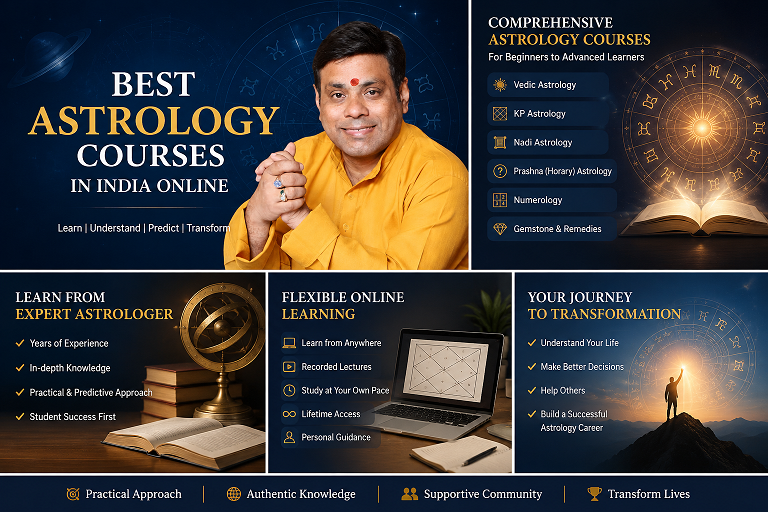
Learn Vedic Astrology Online with the Best Astrology Course

Vedic Astrology is a traditional discipline that combines planetary principles, zodiac signs, houses, Nakshatras, Dashas, Yogas, transits, and horoscope interpretation. For someone who wants to study astrology seriously, simply memorising the meanings of planets or watching occasional astrology videos is not enough. A deeper understanding requires a structured learning process, regular practice, and the ability to connect different factors of a Kundli.
Online education has made this learning journey more accessible. Students can study from home, follow lessons according to their schedules, revisit complex topics, and gradually move from foundational concepts to advanced horoscope analysis.
If you are searching for the Best online astrology course, focus on the overall learning experience rather than only the course name or certification. A valuable program should help you understand the fundamentals, develop practical chart-reading skills, and progressively introduce advanced Jyotish techniques.
For students who have already developed basic knowledge and want to continue their learning, online Jyotish Pallav courses can offer another stage of structured Jyotish education.
Learn Vedic Astrology From the Comfort of Your Home
The biggest advantage of online astrology education is flexibility, making it easier for learners to study the Best online astrology course from the comfort of their own home.
A student does not necessarily need to travel to a classroom or follow a rigid schedule. Lessons can be studied from home and revisited whenever a concept needs additional attention.
This can be useful for:
- Working professionals
- College students
- Homemakers
- Entrepreneurs
- Astrology enthusiasts
- Learners living outside major cities
- Students seeking a structured second level of education
Online learning also allows students to create their own study routine. Someone may dedicate an hour every evening, while another learner may prefer longer weekend sessions.
However, flexibility should not be confused with a lack of structure. A professional learning program should have a logical curriculum that takes students from one concept to the next, helping learners gain greater value from the Best online astrology course experience.
Choosing the Right Path for Astrology Education
Not every astrology course is designed for the same type of learner.
Some programs introduce only the basics, while others focus on advanced predictive methods. Therefore, students should first understand their own learning level.
A comprehensive astrology education may include:
- Introduction to Vedic Astrology
- Grahas and planetary significations
- Rashis and their characteristics
- Lagna and horoscope structure
- Twelve Bhavas
- House lordships
- Planetary aspects
- Planetary conjunctions
- Planetary strength
- Nakshatras
- Yogas
- Doshas
- Dashas
- Gochar and transits
- Divisional charts
- Predictive astrology
- Practical Kundli analysis
- Specialised astrology subjects
The sequence is equally important.
A student who understands the basic structure of a horoscope will find advanced concepts easier to follow. A learner who jumps directly into complicated predictive techniques may struggle to understand why those techniques work.
Start With the Language of Jyotish
The first step in learning Vedic Astrology is becoming comfortable with its terminology.
Terms such as Graha, Rashi, Bhava, Lagna, Nakshatra, Dasha, Gochar, Yoga, and Varga are used throughout Jyotish.
Understanding these terms allows students to follow more advanced lessons without confusion.
For example, knowing that the seventh Bhava is traditionally connected with partnerships is only the beginning. A proper study may involve the seventh lord, planets occupying the house, aspects affecting it, Venus, relevant Dashas, and other supporting factors.
This is why astrology education should teach students how to connect concepts rather than simply memorise definitions.
Understand the Planets Beyond Basic Definitions
The Navagraha form the foundation of Vedic Astrology.
Students initially learn the basic significations of the Sun, Moon, Mars, Mercury, Jupiter, Venus, Saturn, Rahu, and Ketu.
But deeper learning requires understanding how a planet behaves within a particular horoscope.
The Sun may represent authority, individuality, vitality, and leadership. The Moon can relate to emotions, mental patterns, sensitivity, and adaptability. Mars can indicate energy, initiative, courage, and action.
Mercury is connected with communication, learning, reasoning, and analytical abilities. Jupiter relates to wisdom, guidance, knowledge, and expansion. Venus is associated with relationships, comforts, creativity, and refinement.
Saturn can represent discipline, responsibility, persistence, and structure, while Rahu and Ketu introduce distinctive dimensions into horoscope interpretation.
These meanings are only starting points. Placement, lordship, dignity, strength, aspects, conjunctions, and timing can modify how a planet is interpreted.
Learn the Twelve Houses Properly
The twelve Bhavas provide an important framework for studying different areas of life.
A beginner can first learn the general significance of each house. After that, the learner can study house lordships and relationships between different houses.
This is where astrology begins to become more analytical.
For example, career interpretation should not necessarily depend on the tenth house alone. Students may need to consider the tenth lord, planets influencing the tenth house, planetary significators, strength, and relevant timing factors.
Similarly, education, marriage, finances, property, children, family, and other subjects may require the assessment of several connected indicators.
This teaches an important principle: a Kundli should be interpreted as a complete system rather than as a collection of independent placements.
Learn a Step-by-Step Kundli Analysis Method
One of the most useful skills an astrology course can develop is systematic horoscope reading.
Students should learn to approach a Kundli in an organised sequence.
A basic process can begin with the Ascendant and its lord. Then the student can examine planetary placements, house conditions, house lords, aspects, conjunctions, and planetary strength.
After establishing the basic picture, the learner can consider Yogas, Nakshatras, Dashas, transits, and relevant divisional charts.
This method can prevent a common beginner mistake: finding one interesting planetary combination and immediately using it to explain the entire horoscope.
Why Practical Chart Reading Is Essential
Astrology theory provides knowledge, but practice helps develop interpretation skills.
A student may understand the meaning of a particular house in theory but still feel uncertain when several planets influence that house in a real chart.
Practical chart reading helps bridge this gap.
Students can practise identifying:
- Ascendant and its lord
- Planetary placements
- House lordships
- Aspects
- Conjunctions
- Planetary strengths
- Relevant Yogas
- Dasha periods
- Transit influences
The more charts a student studies, the easier it becomes to recognise patterns and organise information.
The objective is not to rush toward predictions. It is to develop a disciplined process for analysing a horoscope.
Study Planetary Strength and Dignity
Planetary strength is an important subject for students moving beyond beginner-level astrology.
A planet’s expression may be influenced by its sign, dignity, house placement, aspects, conjunctions, combustion, retrogression, and other traditional considerations.
Students should learn why these factors matter rather than simply labelling planets as good or bad.
The same planet may have different functional roles in different Kundlis.
Understanding this difference is essential for responsible horoscope interpretation.
Learn Yogas With Context
Yogas are among the most attractive subjects for astrology students.
Many learners are interested in learning famous combinations because they appear to provide direct answers.
However, serious study requires a broader approach.
Students should examine the planets involved, their strength, house positions, lordships, relationships, and the overall condition of the horoscope.
Timing also matters.
Therefore, the presence of a particular Yoga should be studied as one part of the horoscope rather than automatically treated as a guaranteed result.
Understand Dashas and Timing
Vedic Astrology places considerable importance on planetary periods.
Dashas provide a traditional framework for studying different phases of life and the activation of planetary influences.
A student should learn how to connect a running Dasha with the natal horoscope.
The operating planet can be assessed through its house placement, lordship, strength, aspects, conjunctions, and other relevant factors.
This approach helps students understand timing as part of a larger horoscope analysis rather than as an isolated calculation.
Explore Transits Gradually
Gochar, or planetary transit, is another important area of Jyotish learning.
As planets move through the zodiac, their relationship with natal planets and houses can be considered in horoscope analysis.
However, students should avoid relying on one transit alone.
A balanced interpretation may compare transits with the birth chart and relevant planetary periods.
Learning to combine these factors can help students develop more thoughtful predictive techniques.
Understand the Role of Nakshatras
Nakshatras provide another important layer of Vedic Astrology.
Students can begin by learning the 27 Nakshatras, their planetary rulers, sequence, and general characteristics.
As their understanding develops, they can examine how Nakshatra placement contributes to the interpretation of planets and other horoscope factors.
Nakshatra analysis becomes more useful when it is connected with the planet, sign, house, lordship, and timing rather than studied as an isolated list of characteristics.
When Should You Study Divisional Charts?
Divisional charts, or Vargas, belong to the more advanced areas of Jyotish.
Students may eventually study charts such as Navamsa and Dashamsa along with other relevant Vargas.
However, advanced charts should generally be introduced after learners become comfortable with the main birth chart.
The purpose of divisional charts is not to create confusion by adding more information. They should help provide an additional perspective when used appropriately.
A progressive course should therefore introduce them at a suitable stage of the student’s development.
Online Jyotish Pallav Courses for Continued Learning
For learners who have already developed foundational astrology knowledge, online Jyotish Pallav courses can represent an important stage of continued education.
The word “Pallav” refers to developing growth or a fresh leaf. In a progressive Jyotish learning framework, it can symbolise the development that takes place after the basic foundation has been established.
At this stage, learners can focus on connecting concepts.
Instead of simply asking what a planet means, students can begin asking:
- What is the planet’s role in this Kundli?
- Which houses does it rule?
- Where is it positioned?
- How strong is it?
- Which planets influence it?
- What combinations does it form?
- Which timing factors activate it?
- Are there other indicators supporting the same interpretation?
These questions encourage deeper analytical thinking.
Develop an Independent Horoscope Analysis Framework
As students become more experienced, they should gradually develop a consistent way of reading charts.
One possible approach is:
Examine the Ascendant and its lord.
Study the overall planetary arrangement.
Examine the relevant houses and their lords.
Assess planetary strength, aspects, and conjunctions.
Identify important combinations.
Consider Nakshatras where relevant.
Apply appropriate Dasha and timing principles.
Examine transits.
Use relevant divisional charts where appropriate.
Compare multiple indicators before forming an interpretation.
This type of framework can help students become more organised and less dependent on isolated rules.
Who Should Consider an Online Astrology Course?
A structured astrology program can be useful for different learners.
Complete Beginners
If you have never studied astrology, begin with a course that introduces the basics clearly.
Astrology Enthusiasts
If you already read astrology content but have learned through unrelated sources, a structured program can organise your knowledge.
Intermediate Learners
Students who understand basic planets, signs, and houses can progress toward predictive techniques and practical chart analysis.
Serious Jyotish Students
Those who want to explore astrology deeply can continue toward advanced subjects, specialised branches, and professional learning.
Aspiring Practitioners
Learners considering astrology as a professional direction can use structured education as one part of their long-term preparation.
How to Select the Best Online Astrology Course
Before enrolling, consider the following factors.
Examine the Curriculum
Make sure the subjects match your current level and learning goals.
Look for Progressive Learning
The course should show a clear path from basic concepts to advanced subjects.
Check for Practical Application
Chart examples and exercises can make theoretical lessons more useful.
Consider the Teaching Method
Astrology concepts should be explained with reasoning and context.
Review Learning Flexibility
Choose a format that allows you to study consistently alongside your daily responsibilities.
Think About Continued Education
Jyotish is a vast subject, so a learning pathway that allows progression can be valuable for serious students.
Build a Consistent Study Routine
Online learning gives you flexibility, but progress still requires discipline.
Create a weekly schedule for lessons and revision.
Maintain notes on important concepts. Practise reading Kundlis regularly. Return to difficult topics instead of skipping them.
You can also keep a separate notebook for practical observations.
Write down questions that arise during chart analysis and revisit them after studying the relevant concepts.
This process can gradually turn passive learning into active learning.
Common Mistakes New Astrology Students Should Avoid
One of the biggest mistakes is trying to memorise everything.
Another is interpreting one planet or one Yoga without considering the entire horoscope.
Some learners begin with advanced divisional charts before they understand the Lagna chart.
Others make predictions without studying timing techniques.
A structured learning process can help prevent these problems.
The goal should be to understand principles, recognise their limitations, and learn how to apply them appropriately.
Develop Responsible Astrology Skills
Anyone considering serious or professional astrology should understand that technical knowledge is only one part of the learning journey.
Astrological discussions may involve important personal subjects such as relationships, career, finances, education, family, and major decisions.
Therefore, students should learn to communicate interpretations thoughtfully.
Avoiding unnecessary fear and exaggerated certainty is part of responsible astrology practice.
A mature astrologer should distinguish between an astrological interpretation and an absolute guarantee about the future.
Why Online Learning Can Be a Practical Choice
The accessibility of online education allows students to learn Jyotish from different locations.
A learner in a major city can study online just as easily as someone living in a smaller town.
The format can also be useful for international learners interested in Vedic Astrology.
The key is to combine convenience with commitment.
An online course can provide the structure, but the student’s regular practice, revision, and curiosity determine how much they gain from that structure.
Create Your Long-Term Jyotish Learning Roadmap
A clear roadmap can make your astrology education easier to manage.
Start with fundamental concepts.
Then develop your understanding of planets, Rashis, Bhavas, house lordships, aspects, and planetary relationships.
After that, progress toward Nakshatras, Yogas, planetary strength, Dashas, and transits.
Once your foundation is strong, explore divisional charts and specialised predictive techniques.
For students moving beyond the introductory stage, online Jyotish Pallav courses can become part of this progressive learning pathway.
The goal is steady development rather than rushing through every subject.
Why Choose Progressive Jyotish Education?
A progressive learning model allows students to build knowledge in layers.
The first layer introduces the language of astrology.
The next develops chart-reading skills.
The following stages introduce predictive techniques and advanced interpretation.
This structure can reduce confusion and make complex subjects easier to understand.
Instead of collecting disconnected rules, students gradually develop a framework for thinking about a horoscope.
Start Your Jyotish Learning Journey
If you are searching for the Best online astrology course, first identify where you currently stand.
A beginner needs a strong foundation.
An intermediate learner may need practical chart analysis and deeper predictive techniques.
An advanced student may want specialised Jyotish subjects and professional-level learning.
Choosing the appropriate level can make the learning process more productive.
For students who are ready to continue beyond introductory concepts, online Jyotish Pallav courses can provide a pathway toward deeper study and more developed horoscope interpretation.
Take the Next Step Toward Astrology Learning
Learning Jyotish is a continuous process.
You do not need to master every technique immediately. Start by understanding the fundamentals and gradually expand your knowledge.
Study the planets. Learn the Rashis and Bhavas. Understand house lordships. Practise Kundli analysis. Then explore Nakshatras, Yogas, Dashas, transits, and divisional charts.
Most importantly, practise what you learn.
The Best online astrology course should not simply give you information. It should help you develop a method for understanding and applying that information.
For continuing learners, online Jyotish Pallav courses can provide another step toward deeper Jyotish knowledge.
Choose your learning path carefully, study consistently, and allow your understanding to develop naturally over time.
Conclusion
Choosing the Best online astrology course is an important first step for anyone who wants to study Jyotish in a structured and meaningful way. A strong course should help learners understand the fundamentals, develop practical Kundli-reading skills, and gradually explore advanced areas such as Nakshatras, Yogas, Dashas, transits, and divisional charts.
For learners who have already developed basic knowledge and want to move toward deeper study, online Jyotish Pallav courses can represent an important stage of continued learning.
Whether you are beginning your astrology journey or looking to strengthen existing knowledge, focus on understanding rather than memorisation. Practise regularly, revisit difficult concepts, and learn to examine the complete horoscope instead of relying on isolated planetary rules.
With a structured approach, consistent practice, and continued curiosity, your study of Vedic Astrology can develop from basic awareness into a more organised and practical understanding of Jyotish.