
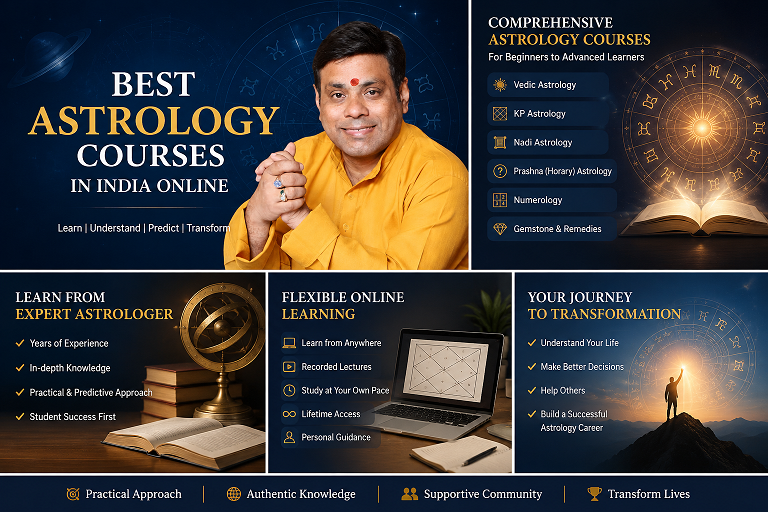
Explore Jyotish Pushpa with the Best Astrology Courses Online

Astrology is not simply about knowing zodiac signs or reading a daily horoscope. Vedic astrology is a systematic discipline that requires an understanding of planets, signs, houses, nakshatras, yogas, dashas, transits, divisional charts, and predictive principles. Anyone who wants to study astrology seriously needs structured learning, consistent practice, and the right progression from basic concepts to advanced interpretation.
For students searching for the best astrology courses online, choosing a structured learning path can make the difference between collecting scattered information and developing genuine horoscope-reading skills. A well-designed course should explain concepts progressively, provide practical interpretation methods, and help learners understand how different astrological factors work together.
The journey of learning Jyotish can begin with fundamental concepts and gradually move toward advanced predictive techniques. Courses such as Jyotish Beej, Jyotish Ankur, Jyotish Pallav, Jyotish Taru, and Jyotish Pushpa can represent different stages of learning, allowing students to progress according to their knowledge and experience.
Why Learn Vedic Astrology Through a Structured Course?
The internet contains thousands of astrology videos, articles, social media posts, and short tutorials. While these resources can introduce learners to individual topics, they often lack a systematic sequence.
A structured astrology course helps organize learning into logical stages. Instead of jumping from planets to marriage predictions and then directly to advanced dashas, students can first understand the foundation and gradually build their analytical ability.
A proper learning structure can help students understand:
- The fundamental principles of Vedic astrology
- Planets and their characteristics
- Rashis and their qualities
- Houses and their significance
- Nakshatras and planetary influences
- Planetary strengths and weaknesses
- Yogas and combinations
- Dashas and event timing
- Transits and their practical application
- Divisional charts
- Advanced predictive techniques
- Practical horoscope interpretation
This step-by-step approach is particularly useful for beginners because it reduces confusion and creates a strong conceptual base.
What Makes the Best Astrology Courses Online Different?
Not every online astrology course offers the same depth or learning experience. Before enrolling, students should look beyond attractive course titles and examine the actual curriculum, teaching methodology, progression, practical exercises, and level of guidance.
The best astrology courses online should ideally combine traditional Jyotish principles with practical chart analysis.
1. A Clear Learning Progression
A good course should have a defined learning path. Students should know what they are expected to learn at beginner, intermediate, advanced, and mastery levels.
This prevents learners from attempting advanced predictive techniques before understanding the fundamental principles required to interpret them correctly.
2. Strong Foundation in Jyotish
The foundation is extremely important. Students should understand the basic relationship between planets, rashis, houses, nakshatras, and other fundamental components of a horoscope.
Without a solid foundation, advanced techniques can become difficult to apply consistently.
3. Practical Horoscope Interpretation
Knowing definitions is different from reading an actual Kundli. Practical chart interpretation helps students understand how multiple planetary factors interact.
For example, a student may know the individual meaning of Jupiter, Saturn, Venus, and Mars. However, actual horoscope analysis requires understanding their house placements, dignity, aspects, conjunctions, lordships, dashas, and other contextual factors.
4. Predictive Astrology Training
Serious learners eventually want to understand how astrologers assess possibilities and timing.
Advanced training may introduce students to dashas, transits, yogas, divisional charts, and other predictive tools. The goal is not simply to memorize combinations but to understand how different factors contribute to an astrological judgment.
Start With the Foundation: Jyotish Beej
Every serious learning journey needs a beginning. A foundation-level course such as Jyotish Beej can introduce students to the essential concepts of Vedic astrology.
Students can explore the meaning of Jyotish, the role of planets and rashis, the structure of a horoscope, planetary states, zodiac principles, and other fundamental concepts.
The foundation stage is particularly suitable for:
- Complete beginners
- Astrology enthusiasts
- Students wanting systematic knowledge
- Learners interested in understanding Kundli basics
- People who have studied astrology informally and want structured learning
A strong foundation makes later subjects much easier to understand.
The objective should not be to memorize hundreds of rules. Instead, students should learn how to think astrologically and recognize relationships between different horoscope components.
Move Toward Intermediate Astrology Learning
After understanding the basics, learners can progress toward intermediate-level studies.
At this stage, students can begin working with actual horoscope structures and more detailed interpretation techniques. Topics may include planetary relationships, houses, nakshatras, yogas, dashas, transits, and practical chart reading.
Intermediate learning is where astrology starts becoming more analytical.
Students begin asking questions such as:
- Why does the same planet produce different results in different charts?
- How do house lordships change interpretation?
- How should planetary combinations be evaluated?
- How can dashas help assess timing?
- How do transits interact with natal placements?
- How should conflicting indications in a horoscope be interpreted?
These questions encourage deeper understanding rather than simple memorization.
Jyotish Pallav: Developing Deeper Interpretation Skills
As learners progress, advanced courses can introduce more sophisticated approaches to horoscope analysis.
Jyotish Pallav can be viewed as a stage where students move beyond elementary chart reading and begin exploring deeper interpretive methods.
At this level, learners may study areas such as:
- Advanced planetary interpretation
- Yogas and their contextual significance
- Dasha-based analysis
- Transit interpretation
- Advanced horoscope combinations
- Bhrigu-based approaches
- Arudha principles
- Practical destiny analysis
The purpose of advanced learning is to develop a more comprehensive approach to a horoscope.
Rather than interpreting one planetary placement independently, students learn to examine the broader pattern of a chart.
Jyotish Taru: Moving Toward Professional-Level Astrology
Once students have developed a reasonable understanding of astrology, they can move into professional predictive studies.
Advanced-level training focuses more strongly on complicated charts and event-oriented analysis. Students may encounter combinations involving multiple planets, challenging yogas, divisional charts, dashas, and transits.
At this stage, practice becomes increasingly important.
Students can work with different types of horoscopes and learn how to organize their analysis logically. This helps develop a professional mindset where conclusions are based on multiple relevant indicators rather than a single planetary placement.
For those who want to eventually provide astrology consultations, this stage can be particularly valuable because professional astrology requires more than theoretical knowledge. It requires disciplined analysis, communication skills, ethical judgment, and continuous practice.
Jyotish Pushpa: Exploring the Deeper Dimensions of Jyotish
For serious students who want to continue beyond advanced predictive astrology, Jyotish Pushpa represents a higher stage of learning.
At this level, the focus can expand toward specialized and multidimensional areas of Vedic astrology. Students can explore advanced predictive methods and deeper classical concepts that require a stronger foundation.
Potential areas of study include:
Advanced Predictive Astrology
Students can develop a more refined approach to timing and interpretation by combining multiple astrological indicators.
Advanced prediction requires patience and careful evaluation because different planetary factors can operate simultaneously.
Divisional Charts
Divisional charts, or Vargas, provide additional layers of interpretation in Vedic astrology.
Learning to understand these charts requires familiarity with the foundational horoscope first. Advanced learners can explore how divisional charts contribute to specific areas of analysis.
Prashna Astrology
Prashna, or horary astrology, provides a specialized approach for addressing questions through a chart created for a particular moment.
It is a distinct area of study and requires its own principles and interpretive discipline.
Muhurta Astrology
Muhurta focuses on selecting appropriate times for important activities.
Students interested in practical applications of astrology can explore how traditional principles are used when evaluating timing for significant events.
Health and Longevity Astrology
Advanced Jyotish studies can also include the interpretation of health-related and longevity indicators within a horoscope.
Because this area is complex and sensitive, it requires careful study of multiple factors rather than relying on isolated planetary combinations.
Spiritual and Karmic Astrology
Vedic astrology also provides a framework for studying themes associated with karma, life patterns, responsibilities, and spiritual development.
This area can encourage learners to look at a horoscope beyond material outcomes and explore broader patterns represented through planetary placements.
Why Practical Learning Matters in Astrology
Reading astrology books can provide valuable knowledge, but practical application is essential for developing interpretation skills.
A student may memorize the meaning of every planet and house but still struggle when presented with an actual horoscope.
Practice helps bridge this gap.
Through repeated chart analysis, students can learn to:
- Identify important planetary factors
- Prioritize relevant combinations
- Compare multiple indications
- Understand planetary strengths
- Examine timing techniques
- Recognize recurring patterns
- Avoid isolated interpretations
- Present conclusions in a logical manner
The more systematically a learner approaches charts, the more confident the analysis can become.
Learn Astrology for Personal Understanding
Not every student wants to become a professional astrologer.
Many people study Vedic astrology because they want to understand their own horoscope and gain a deeper appreciation of Jyotish principles.
Learning astrology can help such students explore:
- Personality patterns
- Career tendencies
- Relationship themes
- Financial tendencies
- Important life periods
- Strengths and challenges
- Planetary cycles
- Spiritual interests
A structured course allows personal learners to study these subjects without depending entirely on random online information.
Learn Astrology for a Professional Career
For those considering astrology as a professional field, structured education can provide a more organized foundation.
Professional astrology involves much more than predicting events. An astrologer needs to understand charts carefully, communicate responsibly, handle uncertainty, and avoid exaggerated or fear-based claims.
A serious course can help learners develop:
- Technical knowledge
- Analytical thinking
- Horoscope interpretation skills
- Predictive methodology
- Consultation discipline
- Ethical awareness
- Continued learning habits
The objective should be to build competence gradually rather than expecting instant mastery.
Choose a Course According to Your Current Level
One of the biggest mistakes beginners make is choosing an advanced course without understanding the prerequisites.
A better approach is to evaluate your existing knowledge.
New to astrology? Start with the basics and build a clear understanding of fundamental Jyotish concepts.
Know the fundamentals already? Choose an intermediate course to strengthen your horoscope analysis and interpretation skills.
Experienced in Kundli reading? Explore advanced astrology courses to enhance your predictive knowledge and learn deeper Jyotish techniques.
Experienced learners looking for specialized and higher-level studies can explore Jyotish Pushpa and other advanced learning stages.
This progression makes learning more manageable and prevents unnecessary confusion.
Learn From Experience, But Build Your Own Skill
An experienced teacher can provide direction, methodology, and practical perspective, but students still need to practice independently.
Astrology is a discipline where continuous learning matters.
Learners should develop the habit of studying charts, comparing indications, reviewing predictions, revisiting classical principles, and improving their analytical process.
The purpose of an astrology course should therefore be to teach students how to analyze, not simply what to memorize.
Why Choose Vinay Bajrangi Astrology Courses?
A structured astrology education journey can help learners move from basic Jyotish concepts toward advanced predictive and specialized techniques.
The course pathway is designed around progressive stages so that learners can develop their knowledge step by step. From foundation-level learning to advanced studies such as Jyotish Pushpa, students can choose a learning level that matches their existing understanding and goals.
For learners searching for the best astrology courses online, this structured approach can provide a practical alternative to scattered learning from unrelated sources.
The emphasis on systematic study, horoscope interpretation, advanced techniques, and progressive learning makes the journey suitable for beginners as well as serious students who want to deepen their Jyotish knowledge.
Begin Your Astrology Learning Journey Today
Learning Vedic astrology is a long-term journey. It starts with understanding the basics and gradually develops through practice, observation, interpretation, and advanced study.
You do not need to know everything before beginning. You need the right starting point and a willingness to learn consistently.
Whether your goal is to understand your own Kundli, explore astrology as a serious subject, improve your horoscope-reading ability, or work toward professional practice, a structured learning path can help you progress with greater clarity.
From foundation-level concepts to advanced predictive techniques and the deeper studies of Jyotish Pushpa, every stage can add another layer to your understanding of Jyotish.
If you are ready to move beyond random astrology videos and develop systematic knowledge, now is a good time to begin your learning journey. Choose the course level that matches your experience, learn step by step, practice regularly, and build your understanding of Vedic astrology with a structured approach.
Enroll today and take your next step toward deeper Jyotish learning.
Conclusion
Learning Vedic astrology is a gradual journey that requires strong fundamentals, regular practice, and a structured approach. Choosing the best astrology courses online can help students move from basic planetary concepts to advanced horoscope analysis with greater clarity and confidence.
A progressive learning path—from foundational Jyotish concepts to advanced studies such as Jyotish Pushpa—allows learners to develop their knowledge step by step. Whether you want to understand Kundli analysis for personal learning or explore astrology as a professional skill, systematic education can provide the right direction.
Start your astrology learning journey today, choose a course according to your experience level, and continue developing your Jyotish knowledge through consistent study and practical horoscope analysis.