
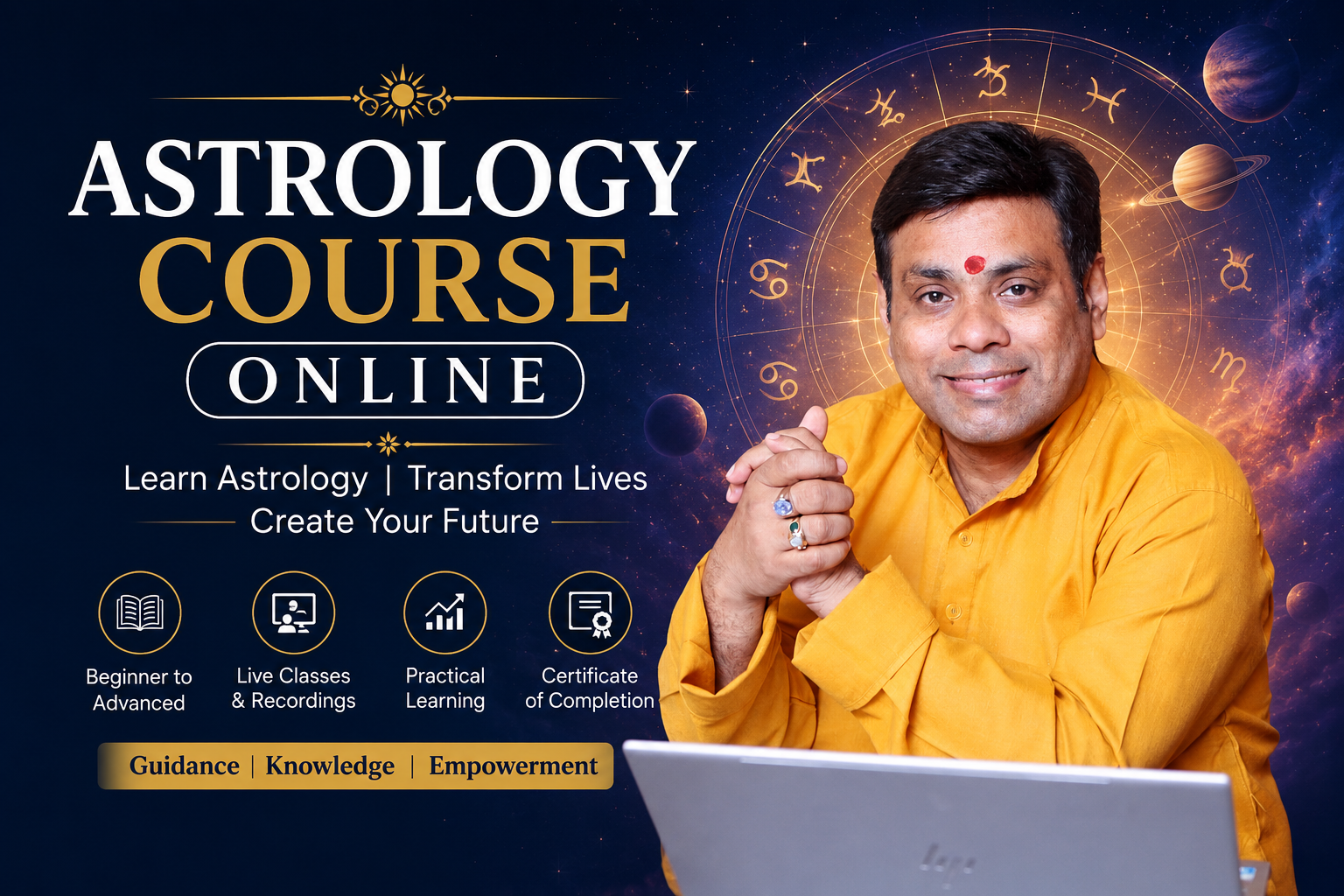
Best Online Astrology Course with Certificate in India

Astrology has been an important part of Indian knowledge traditions for centuries. Vedic astrology, also known as Jyotish, focuses on interpreting planetary positions, zodiac signs, houses, Nakshatras, and planetary periods to understand a birth chart. Today, people interested in learning this traditional discipline can explore structured online courses that combine fundamental concepts with practical horoscope analysis.
An online astrology course with certificate India is a suitable option for learners who want to study astrology systematically from home. Whether you are a beginner, an astrology enthusiast, or someone interested in developing professional skills, a structured learning programme can help you understand astrological principles step by step.
However, learning astrology requires more than memorising planetary meanings. Students need to understand how different chart factors interact, how to interpret planetary relationships, and how to apply traditional principles to practical examples.
Another important area is Vedic astrology subject selection training, which explores the traditional astrological approach to understanding a student’s educational interests and possible academic directions. This subject is particularly relevant to learners who want to explore specialised applications of astrology beyond basic horoscope reading.
At Vinay Bajrangi, students can explore structured Vedic astrology learning programmes designed for different levels of knowledge. With an organised learning path, students can build a foundation, develop chart-reading skills, and progress towards more advanced concepts according to their learning goals.
Why Choose an Online Astrology Course with Certificate in India?
Online education has made it easier for students to learn specialised subjects without travelling to a classroom. Astrology learners can study from their homes, revisit lessons, and gradually develop their understanding of complex concepts.
An online astrology course with certificate India can be particularly useful for people who want a structured learning experience rather than depending entirely on scattered online information.
1. Learn at Your Own Pace
Beginners often find astrology confusing because the subject includes several interconnected concepts. Planetary positions, zodiac signs, houses, Nakshatras, yogas, and dashas must be understood together.
A structured online course helps learners follow a planned sequence. They can first understand the basics before progressing to chart interpretation and predictive techniques.
2. Develop Systematic Chart-Reading Skills
Reading a horoscope requires a methodical approach. A student must learn how to identify the ascendant, understand house placements, examine planetary relationships, and consider the broader chart.
Structured training can help learners move beyond isolated interpretations and understand how different astrological factors are traditionally evaluated together.
3. Explore Practical Applications
Astrology education becomes more meaningful when theoretical concepts are connected with practical chart examples. Case-based learning can help students understand how traditional principles are applied and why interpretations require context.
Learners should also develop the habit of questioning assumptions, recognising uncertainty, and avoiding absolute predictions.
4. Progress Towards Advanced Learning
Students may begin with basic planetary concepts and gradually study more complex topics, such as divisional charts, planetary periods, yogas, transits, and specialised branches of Jyotish.
A progressive curriculum helps learners identify their current level and choose an appropriate next step.
5. Work Towards Course Certification
Some learners prefer a programme that offers a certificate after completing its prescribed requirements. Certification can document course participation or achievement, depending on the programme.
Before enrolling, students should check the course syllabus, assessment requirements, certificate conditions, and the issuing institution. A course certificate should not automatically be interpreted as a government-recognised academic qualification or a guarantee of professional competence.
What Will You Learn in an Online Astrology Course?
A well-structured astrology course introduces the fundamental concepts before moving towards more detailed interpretation.
The exact curriculum depends on the programme, but the following subjects commonly form part of a progressive Vedic astrology learning journey.
Understanding the Nine Planets
Students begin by learning about the nine Grahas used in traditional Vedic astrology: the Sun, Moon, Mars, Mercury, Jupiter, Venus, Saturn, Rahu, and Ketu.
They explore the traditional significations associated with each planet and learn why a planet’s interpretation depends on its placement, house ownership, relationships, and other chart factors.
Learning the Twelve Zodiac Signs
The twelve Rashis form an essential part of horoscope interpretation. Students learn their traditional qualities, planetary rulers, elements, and other classifications.
Understanding zodiac signs helps learners interpret how planetary placements are described within a birth chart.
Understanding the Twelve Houses
The twelve houses, or Bhavas, represent different areas of life within the traditional astrological framework. Students study their significations and learn how house lords and planetary placements are interpreted.
This knowledge forms an important foundation for understanding topics such as education, career, relationships, family, and personal development.
Studying Nakshatras and Planetary Relationships
Nakshatras add another layer to traditional chart interpretation. Students can learn about the twenty-seven Nakshatras, their characteristics, and their role in different astrological techniques.
Planetary friendships, conjunctions, aspects, and other relationships help learners understand why an interpretation cannot depend on a single placement.
Learning Dashas and Timing Techniques
Planetary periods, including dashas and antardashas, are used in traditional Vedic astrology to organise interpretations around different periods of life.
Students learn the underlying concepts and how astrologers traditionally consider these periods alongside the birth chart. Such methods should be understood as astrological traditions rather than scientifically validated forecasting techniques.
What Is Vedic Astrology Subject Selection Training?
Choosing an academic stream or subject can be a significant decision for students. It may influence their learning experience, future educational opportunities, and professional interests.
Vedic astrology subject selection training focuses on the traditional astrological concepts used to discuss educational inclinations and subject-related questions. It is a specialised application of Jyotish that learners may explore after understanding basic chart interpretation.
In traditional astrology, practitioners may examine planetary placements and houses associated with learning, intelligence, interests, and education.
The fourth house is commonly associated with education and foundational learning, while the fifth house is traditionally linked with intelligence, learning abilities, and creativity. Mercury is associated with communication and reasoning, and Jupiter with knowledge and wisdom.
An astrologer may consider these and other factors within the complete birth chart when discussing educational themes.
However, astrology cannot reliably determine which subject a student will perform best in. Actual academic performance, personal interests, aptitude assessments, school counselling, and available educational opportunities should remain the primary considerations.
Who Can Benefit from Subject Selection Training?
This specialised area may interest:
- Astrology students who want to explore educational applications of Jyotish.
- Learners who have already studied basic planetary placements and house significations.
- Astrology enthusiasts interested in traditional interpretations of academic interests.
- Students seeking to expand their understanding of specialised horoscope analysis.
- Practitioners who want to study educational questions as a distinct area of astrological interpretation.
A learner should first establish a solid foundation in birth chart reading. Without understanding houses, planetary relationships, and chart context, specialised interpretations can become superficial or misleading.
How Vedic Astrology Subject Selection Training Is Approached
The traditional astrological approach to subject selection involves examining multiple chart factors rather than relying on one planet or house.
1. Understanding Educational Houses
Students learn the traditional meanings of houses associated with education, knowledge, intelligence, and professional direction.
They explore how these houses are interpreted within a complete horoscope and why individual placements should not be considered in isolation.
2. Studying Relevant Planetary Significations
Mercury, Jupiter, the Sun, the Moon, and other planets may receive attention depending on the question and the astrological method being followed.
Students examine their traditional associations and learn how astrologers interpret planetary relationships.
3. Examining Planetary Combinations
Astrological interpretations may consider conjunctions, aspects, house ownership, and other combinations.
Training in this area helps learners understand the importance of context and the limitations of drawing conclusions from a single planetary factor.
4. Applying Concepts to Practical Examples
Practical exercises allow students to work through example charts and understand the reasoning behind a traditional interpretation.
These exercises should encourage careful analysis rather than fixed assumptions about a student’s abilities or future.
5. Connecting Astrological Study with Responsible Guidance
When discussing educational choices, students should learn to distinguish traditional astrological interpretations from evidence-based educational guidance.
A student’s actual interests, academic record, learning preferences, and career aspirations should always be respected. Astrology should never be used to restrict educational opportunities or pressure a student into a particular subject.
How to Choose the Right Online Astrology Course
Before enrolling in an online astrology course with certificate India, consider your current knowledge, learning objectives, and preferred level of study.
Beginners
If you are new to astrology, choose a course that explains terminology, planets, zodiac signs, houses, and basic chart structure in a clear sequence.
A strong foundation makes advanced learning easier and reduces confusion when you begin interpreting complete horoscopes.
Intermediate Learners
Students who already understand basic concepts can look for training in house ownership, planetary relationships, Nakshatras, yogas, dashas, and practical chart analysis.
At this stage, exercises and case studies can help connect theory with interpretation.
Advanced Learners
More experienced students may wish to explore divisional charts, advanced predictive methods, specialised applications, and detailed horoscope interpretation.
The right course should build upon previous knowledge instead of repeating basic material without offering meaningful progression.
Check the Course Structure and Certificate
Before making a decision, review the curriculum, instructor’s experience, teaching format, assessment process, learning materials, and certificate conditions.
If your goal is professional development, also consider opportunities for supervised practice, ethical guidance, and continued learning. Completing a course does not automatically guarantee employment, clients, or predictive accuracy.
Learn Vedic Astrology with Vinay Bajrangi
For learners interested in a structured approach to Jyotish, Vinay Bajrangi offers a progression of astrology courses for different stages of learning.
The learning pathway includes foundation, intermediate, and advanced programmes, allowing students to develop their understanding gradually.
At the foundation stage, learners can study the basic concepts of Vedic astrology, including planets, zodiac signs, and traditional astrological principles. Intermediate learning introduces chart reading, houses, Nakshatras, and timing techniques. Advanced study explores more complex concepts and detailed interpretation.
This progressive approach can help students organise their learning and understand how foundational concepts connect with advanced techniques.
Those searching for an online astrology course with certificate India should review the specific programme requirements and certification details before enrolling. Students interested in Vedic astrology subject selection training should also establish whether their chosen learning path includes the specialised topics they wish to study.
Selecting a course that matches your current knowledge and long-term objectives can make your learning experience more focused and productive.
Why Structured Astrology Training Matters
Astrology contains many interconnected concepts, and studying them without a clear learning sequence can make the subject difficult to understand.
Structured training encourages learners to build knowledge progressively, practise chart interpretation, and review their understanding through examples.
It can also help students recognise common mistakes, such as interpreting a single planetary placement as a complete prediction or ignoring the wider chart context.
Equally important is learning to communicate interpretations responsibly. Astrology students should avoid creating unnecessary fear, making absolute promises, or presenting traditional interpretations as established scientific facts.
Whether you are interested in personal learning or future professional development, a thoughtful approach to astrology education can help you build a more organised understanding of the subject.
Enrol in an Online Astrology Course Today
If you want to learn Vedic astrology systematically, choosing a structured programme is an important first step. An online astrology course with certificate India can provide a planned learning journey for understanding traditional astrological concepts, developing chart-reading knowledge, and progressing towards advanced topics.
If your interests include specialised applications, Vedic astrology subject selection training can introduce the traditional principles used to discuss educational questions and academic interests.
Explore the available learning programmes at Vinay Bajrangi and select a course that matches your experience and learning goals. Review the syllabus, teaching format, and certificate requirements before making your decision.
Begin with the fundamentals, practise regularly, and progress towards more complex concepts as your understanding improves. A consistent and responsible learning approach can help you develop a stronger foundation in Vedic astrology.
Conclusion
Learning astrology requires patience, structured study, and regular practice. An online astrology course with certificate India can help students follow an organised curriculum, understand foundational concepts, and progress towards more advanced areas of Jyotish.
Vedic astrology subject selection training offers a specialised area of study for those interested in the traditional astrological interpretation of educational questions. However, real academic decisions should always consider a student’s interests, aptitude, performance, and professional educational guidance.
By choosing a programme that suits your current level and learning objectives, you can build your knowledge step by step. Explore the astrology courses offered by Vinay Bajrangi, review the available curriculum, and begin your learning journey with clear goals and realistic expectations.