
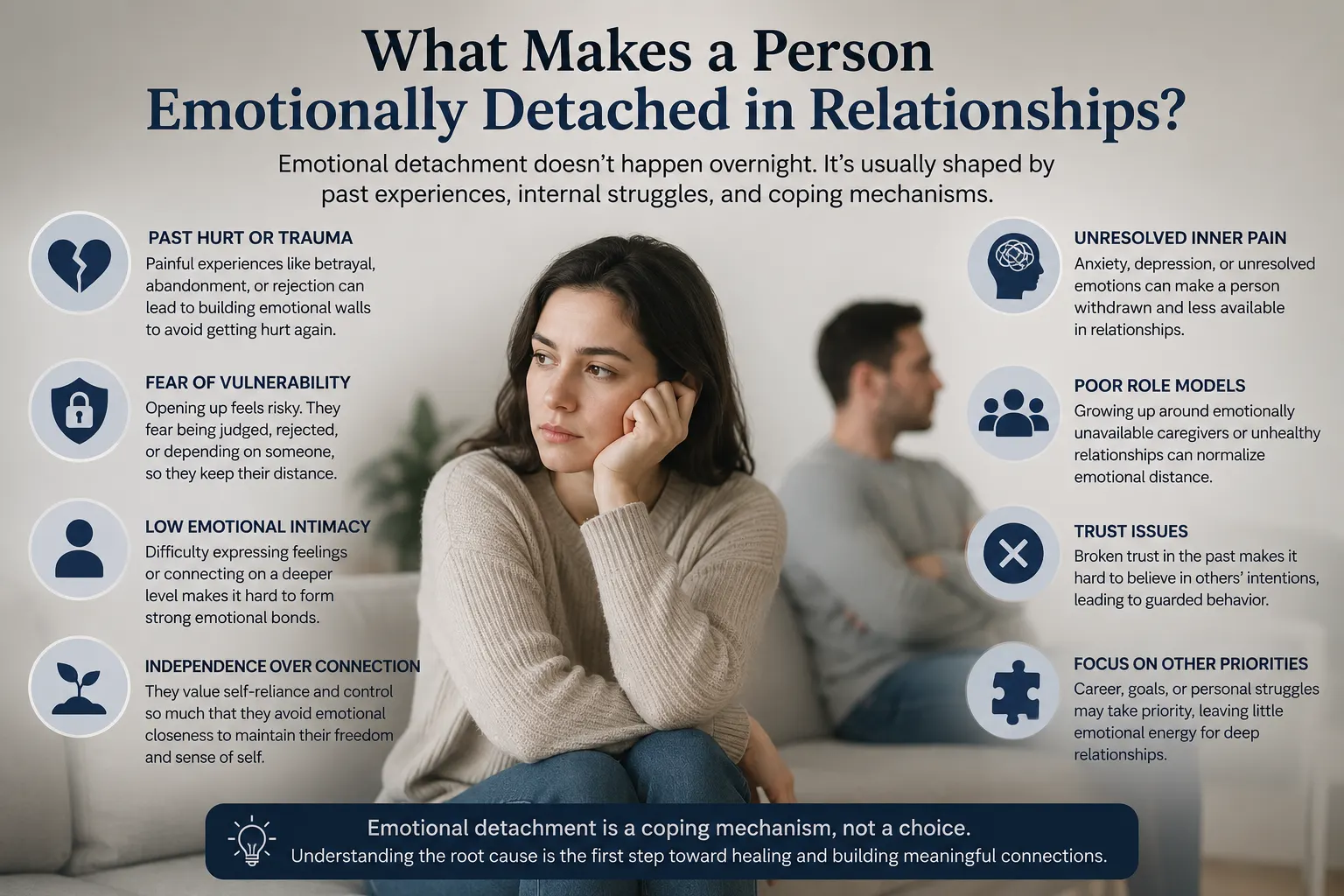
What Makes a Person Emotionally Detached in Relationships?

Have you ever been with someone who seemed physically present but emotionally miles away?
Maybe they reply to your messages, show up when needed, and even say they care—but something still feels missing. Conversations stay on the surface. Vulnerability feels uncomfortable. And no matter how hard you try, there’s always an invisible wall between you and them.
An emotionally detached person doesn’t necessarily lack feelings. In fact, many people who appear distant feel emotions deeply. The challenge is that expressing those emotions, trusting others with them, or even understanding them can feel overwhelming.
If you’ve ever found yourself wondering, “Why am I emotionally detached?” or trying to understand emotional detachment in relationships, you’re not alone. This is a question many people quietly struggle with, whether they are the detached partner or the one feeling disconnected.
Let’s explore what emotional detachment really means, what causes it, and whether it’s possible to build deeper emotional connections again.
What Does It Mean to Be Emotionally Detached in Relationships?
Being emotionally detached in relationships doesn’t mean someone doesn’t care.
It usually means they struggle to connect with emotions in a way that creates closeness with another person.
They may:
- Avoid discussing feelings
- Pull away during emotional conversations
- Find it difficult to trust others
- Prefer independence over emotional reliance
- Feel uncomfortable when someone gets too close
From the outside, this can look cold or indifferent. But internally, things are often more complicated.
Many emotionally detached individuals want connection. They simply don’t know how to navigate emotional vulnerability comfortably.
Signs of Emotional Detachment in Relationships
Not every quiet or independent person is emotionally detached. The difference lies in how someone handles emotional intimacy.
Some common signs include:
Difficulty Expressing Feelings
When asked how they feel, they may struggle to find words.
Instead of talking about emotions, they focus on facts, tasks, or practical matters.
Avoiding Vulnerability
Sharing fears, insecurities, or personal struggles feels risky.
As a result, conversations remain emotionally shallow even after months or years together.
Pulling Away During Conflict
Healthy relationships often require uncomfortable discussions.
An emotionally detached partner may shut down, become silent, or physically leave when emotions become intense.
Feeling Disconnected Despite Being Together
One of the most painful experiences in an emotionally distant relationship is feeling lonely while sitting right beside someone.
The relationship exists, but the emotional closeness doesn’t.
What Causes Emotional Detachment?
There isn’t one single reason.
The causes of emotional detachment are often layered and deeply personal.
Childhood Experiences
Many emotional patterns begin early in life.
If someone grew up in an environment where emotions were criticized, ignored, or punished, they may have learned that expressing feelings isn’t safe.
Over time, emotional distance becomes a form of self-protection.
For example:
- Parents who dismissed emotions
- Frequent criticism
- Lack of affection
- Unpredictable family environments
These experiences can shape how a person approaches relationships later in life.
Past Relationship Trauma
Heartbreak changes people.
A painful breakup, betrayal, abandonment, or repeated disappointment can make someone reluctant to open up again.
They may unconsciously think:
“If I don’t get too attached, I can’t get hurt.”
While this strategy may reduce emotional risk, it also limits emotional intimacy.
Fear of Rejection
Some emotionally detached individuals aren’t avoiding connection.
They’re avoiding rejection.
Keeping people at a distance can feel safer than risking emotional exposure.
Ironically, the fear of losing connection often creates the very distance they fear.
Chronic Stress and Emotional Exhaustion
Life pressures can affect emotional availability.
When someone is overwhelmed by work, family responsibilities, financial concerns, or personal challenges, emotional energy becomes limited.
Instead of connecting, they may focus entirely on surviving daily demands.
This kind of detachment is often temporary but can still impact relationships significantly.
Low Emotional Awareness
Some people genuinely struggle to identify what they’re feeling.
Psychologists sometimes refer to this as difficulty with emotional recognition.
If someone cannot understand their own emotions clearly, communicating them to a partner becomes even harder.
Why Am I Emotionally Detached?
If you’ve asked yourself this question, it’s worth approaching it with curiosity rather than judgment.
Emotional detachment is often a learned response rather than a personality flaw.
Consider asking yourself:
- Do I feel uncomfortable depending on others?
- Do emotional conversations make me anxious?
- Have I experienced significant emotional hurt in the past?
- Do I often suppress my feelings instead of expressing them?
- Was emotional expression encouraged in my family growing up?
The answers may reveal patterns that developed long before your current relationship.
Awareness doesn’t solve everything overnight, but it creates a starting point.
How Emotional Detachment Affects Relationships
Relationships thrive on emotional connection.
Without it, even strong attraction and compatibility can struggle to survive.
Communication Becomes Surface-Level
Partners may talk about schedules, responsibilities, and daily activities but avoid deeper conversations.
Over time, emotional intimacy fades.
Misunderstandings Increase
The detached partner may believe they’re showing love through actions.
The other partner may interpret emotional distance as lack of care.
Both people can feel misunderstood.
Resentment Slowly Builds
When emotional needs go unmet repeatedly, frustration tends to grow.
One partner may feel ignored.
The other may feel pressured.
Neither experience feels good.
Trust Becomes Difficult
Trust isn’t built only through loyalty.
It’s also built through emotional openness.
Without vulnerability, true closeness becomes difficult to sustain.
Can Emotional Detachment Be Changed?
Yes—but it requires patience.
Emotional habits developed over years rarely disappear in a few weeks.
The encouraging part is that emotional connection is a skill.
Like any skill, it can improve with practice.
Some helpful steps include:
Learning to Recognize Emotions
Start paying attention to emotional reactions throughout the day.
Instead of saying:
“I’m fine.”
Try asking:
“What exactly am I feeling right now?”
The answer may be frustration, disappointment, anxiety, loneliness, excitement, or something else entirely.
Naming emotions is often the first step toward expressing them.
Practicing Small Acts of Vulnerability
You don’t have to share your deepest fears immediately.
Start small.
Talk about a concern, a worry, or something meaningful that happened during your day.
Emotional intimacy grows gradually.
Improving Communication
Healthy communication doesn’t require perfection.
It requires honesty.
Simple statements such as:
- “I’m struggling to explain how I feel.”
- “This conversation makes me uncomfortable.”
- “I need some time to process my emotions.”
can create more connection than complete silence.
Seeking Professional Support
Sometimes emotional detachment is linked to unresolved experiences that are difficult to process alone.
A therapist or counselor can help identify patterns and develop healthier emotional habits.
The Role of Astrology in Understanding Relationship Patterns
While emotional detachment is often explored through psychology, some people also look toward astrology for additional insights into relationship tendencies.
Astrology doesn’t determine your fate, but many believe it can reveal emotional patterns, communication styles, and relationship preferences reflected in a birth chart.
For those interested in relationship compatibility and emotional bonding, exploring concepts related to love marriage astrology can provide another perspective on how individuals connect emotionally and romantically.
What If Your Partner Is Emotionally Detached?
This situation can be challenging.
It’s natural to want more closeness from someone you care about.
However, forcing emotional openness rarely works.
Instead:
- Communicate your needs clearly
- Avoid constant criticism
- Encourage honest conversations
- Recognize small improvements
- Maintain healthy boundaries
At the same time, remember that a relationship requires effort from both people.
You can create opportunities for connection, but you cannot do the emotional work on someone else’s behalf.
Paying Attention to Emotional Cycles
Interestingly, emotional states aren’t always permanent.
People often go through periods where they feel more connected, reflective, or emotionally available.
Some individuals follow psychological frameworks, while others pay attention to personal reflection practices, journaling, or even a Daily Horoscope to gain insight into their emotional patterns and relationship mindset.
Regardless of the approach, self-awareness remains the key factor.
The more aware you become of your emotional habits, the easier it becomes to change them.
READ MORE – Why Pisces May Experience More Luck Through Upcoming Planetary Transits
Final Thoughts
Being emotionally detached in relationships doesn’t mean someone is incapable of love.
More often, it reflects protective habits that developed over time.
Whether those habits came from childhood experiences, heartbreak, fear of rejection, or emotional overwhelm, they can influence how a person connects with others.
The good news is that emotional connection isn’t reserved for a lucky few.
It can be learned, strengthened, and rebuilt.
The first step is simply recognizing the pattern.
From there, honest self-reflection, healthier communication, and a willingness to be vulnerable can gradually replace distance with genuine connection.
And sometimes, understanding why the wall exists is exactly where healing begins.