
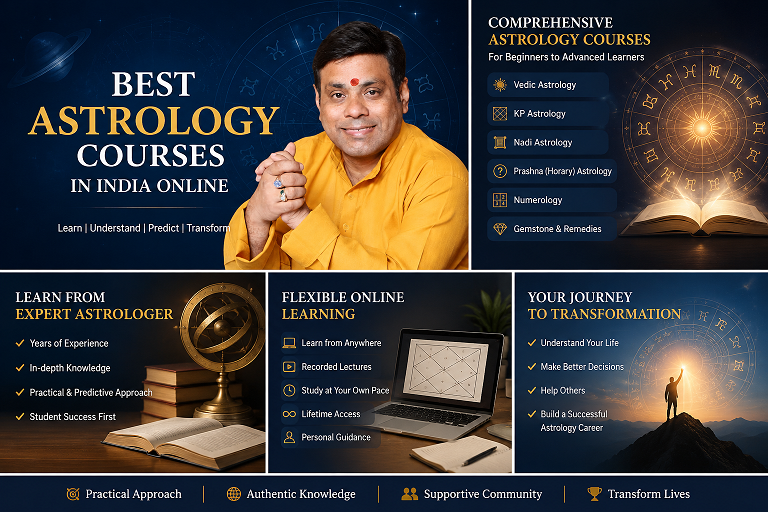
Best Online Vedic Astrology Course and Jyotish Pushpa

Learning Vedic Astrology can be a meaningful journey for anyone interested in understanding planets, Rashis, Bhavas, Nakshatras, Dashas, Yogas, and horoscope interpretation. However, beginners often find astrology difficult because the subject includes many connected concepts. A structured learning path can make the process easier and help students develop practical knowledge step by step.
The best online vedic astrology course should provide clear explanations, systematic lessons, practical horoscope analysis, and progressive learning. Beginners should first understand the basic principles of Jyotish before moving toward advanced prediction techniques.
For learners who want to continue developing their knowledge, Jyotish Pushpa can represent a further stage in the journey of learning and understanding Vedic Astrology. With consistent study and practical application, students can gradually strengthen their horoscope-reading abilities and develop a deeper understanding of traditional Jyotish.
Why Choose the Best Online Vedic Astrology Course?
Online learning has made Vedic Astrology more accessible to students who want to study from home. However, not every online program offers the same learning structure.
The best online vedic astrology course should be designed to help beginners understand astrology in a logical sequence. Instead of presenting complicated rules immediately, the learning process should begin with fundamental concepts and gradually introduce advanced topics.
A well-structured learning journey can help students understand:
- Planets and their significations
- Twelve Rashis
- Twelve Bhavas
- Ascendant and horoscope structure
- Nakshatras
- Planetary aspects
- Planetary strength
- Yogas
- Dashas
- Transits
- Horoscope interpretation
- Practical prediction techniques
This approach allows students to build knowledge progressively without feeling overwhelmed.
What Should Beginners Learn First?
Beginners should start with the basic language of Vedic Astrology.
The first stage should explain the purpose of a birth chart and how planetary positions are represented in a Kundli. Students should understand the roles of planets, signs, and houses before attempting detailed predictions.
The Navgrahas form an important foundation. Learners can begin by understanding the traditional significations of the Sun, Moon, Mars, Mercury, Jupiter, Venus, Saturn, Rahu, and Ketu.
After learning the planets, students can explore the twelve Rashis and understand their qualities and characteristics.
This foundation makes it easier to understand how planets behave when placed in different signs.
Understand the Twelve Houses
The twelve Bhavas are another essential part of horoscope analysis.
Each house is traditionally associated with different areas of life. For example, the first house relates to personality and physical constitution, the second to wealth and family, the fifth to education and creativity, the seventh to partnerships and marriage, and the tenth to career and professional responsibilities.
Beginners should learn these meanings carefully.
However, students should also understand that a house should not be interpreted independently. Its lord, occupants, aspects, planetary strength, and other horoscope factors can influence its results.
This is why practical learning is important.
Learn Horoscope Reading Step by Step
Reading a birth chart requires more than identifying planets.
A student should learn how to examine the entire horoscope systematically.
A basic chart-reading process can include:
- Identifying the Ascendant.
- Studying the Ascendant lord.
- Understanding the twelve houses.
- Identifying planetary placements.
- Studying house ownership.
- Examining aspects and conjunctions.
- Understanding planetary strength.
- Observing important Yogas.
- Studying relevant Dashas.
- Considering planetary transits.
This method encourages learners to connect different astrological factors before reaching a conclusion.
Move Beyond Memorizing Astrology Rules
Memorization can help students learn basic concepts, but meaningful astrology requires interpretation.
For example, a learner may memorize that Jupiter is traditionally associated with wisdom, knowledge, guidance, expansion, and prosperity. However, Jupiter’s influence in an individual horoscope depends on its sign, house, lordship, aspects, conjunctions, strength, and planetary periods.
Therefore, students should learn how to analyze context.
The best online vedic astrology course should encourage learners to understand the reasoning behind an interpretation rather than simply memorize hundreds of isolated rules.
This helps students become more confident when working with complete birth charts.
Study Nakshatras for Deeper Understanding
Nakshatras add another important dimension to Vedic Astrology.
The zodiac is traditionally divided into 27 Nakshatras, each with its own characteristics and associations. Beginners can first learn the basic structure of the Nakshatra system before exploring more advanced applications.
Students can gradually understand how planetary placement in a Nakshatra can provide additional information during horoscope analysis.
Nakshatra study can also support deeper understanding of personality, timing, and planetary influences.
However, it is best introduced after students have developed a strong understanding of planets, signs, and houses.
Understand Dashas and Planetary Timing
Timing is an important part of predictive astrology.
A birth chart may contain various possibilities, but Vedic Astrology traditionally uses planetary periods such as Mahadasha and Antardasha to examine when certain planetary themes may become more active.
Beginners should first understand what Dashas represent and how they connect with the birth chart.
Later, students can learn how to assess planetary periods in relation to career, education, relationships, finances, and other areas of life.
A Dasha should not be interpreted alone. The overall horoscope and supporting planetary factors should always be considered.
Learn Through Practical Horoscope Analysis
Theory becomes more useful when students apply it to actual birth charts.
A learner may understand the definitions of planets and houses but still find a complete horoscope difficult to interpret.
Practical chart analysis helps bridge this gap.
Students can begin with simple charts and gradually work with more complex horoscopes. They can practice identifying important planetary placements and then compare multiple factors influencing the same area of life.
For example, career analysis may involve the tenth house, its lord, relevant planets, planetary strength, Dashas, and transits. It should not depend on one isolated placement.
Regular practice helps students develop analytical thinking.
Why Online Learning Can Benefit Astrology Students
An online astrology program can provide flexibility for learners with different schedules.
Students can study from home and organize their learning around work, education, family responsibilities, or other commitments.
This flexibility makes online learning suitable for people who want to study astrology without changing their daily routine.
However, online learning requires consistency.
Students should create a regular study schedule and revise previously learned concepts. Short, consistent study sessions can help maintain continuity and improve understanding.
Develop a Strong Foundation Before Advanced Learning
Many beginners are attracted to advanced prediction techniques because they want to make predictions quickly. However, advanced astrology becomes easier when the fundamentals are strong.
Before studying complex techniques, students should understand:
- Planets
- Rashis
- Bhavas
- Ascendant
- House lords
- Planetary aspects
- Planetary strength
- Nakshatras
- Yogas
- Dashas
- Transits
Once these concepts become familiar, students can move toward deeper analysis.
A progressive approach helps prevent confusion and creates a stronger foundation for advanced Jyotish learning.
Understanding Jyotish Pushpa
Jyotish Pushpa can be viewed as part of a continuing astrology learning journey for students who want to expand their understanding of Jyotish.
The term represents growth and development in the learning process. Just as a plant develops gradually, astrology knowledge also grows through consistent education, practice, observation, and deeper study.
For learners who have already developed basic astrology knowledge, continuing toward higher levels can provide an opportunity to explore more detailed horoscope analysis.
The transition from beginner learning to advanced study should happen gradually. Strong fundamentals remain essential at every stage.
Why Jyotish Pushpa Can Support Continued Learning
Astrology is a broad subject, and completing introductory lessons does not mean the learning journey is finished.
Students can continue exploring more advanced concepts, including deeper planetary analysis, complex combinations, predictive methods, timing techniques, and practical horoscope interpretation.
Jyotish Pushpa can therefore be positioned as part of a progressive learning journey for students who want to continue developing their Jyotish knowledge.
The focus should remain on understanding astrology rather than simply collecting information.
Develop Practical Prediction Skills
Prediction requires careful analysis.
Students should learn to compare different horoscope indications and identify which factors are stronger or more relevant to the question being studied.
For example, when analyzing education, a learner may examine the relevant houses, planets, planetary strength, combinations, and timing factors. When studying career, different houses and planetary influences may become important.
This analytical approach helps students avoid making quick conclusions.
A structured course can gradually introduce these methods so beginners can develop confidence without becoming overwhelmed.
Learn Astrology for Personal Knowledge
Not everyone studies astrology to become a professional astrologer.
Some people want to understand their own horoscope, learn traditional Jyotish principles, or develop a deeper interest in Indian astrology.
For these learners, a structured beginner course can provide a better foundation than relying only on generalized zodiac predictions.
Students can learn how to identify planetary placements and understand the basic structure of their own Kundli.
This creates a more meaningful learning experience.
Learn Astrology for Professional Development
Some students may eventually want to pursue astrology professionally.
For them, learning should include both theory and practical chart interpretation.
A professional approach requires patience, analytical thinking, communication skills, responsible interpretation, and continuous education.
Students should learn to examine the complete horoscope before making an interpretation.
They should also understand that astrology involves many traditional principles and requires ongoing study.
How to Choose the Right Astrology Learning Program
Before choosing an online astrology program, consider your current level and long-term goals.
Check the Learning Level
Beginners should choose a course that starts with fundamental concepts.
Review the Curriculum
Look for important topics such as planets, Rashis, Bhavas, Nakshatras, Dashas, Yogas, and horoscope analysis.
Look for Practical Learning
A course should encourage students to apply theoretical concepts to birth charts.
Consider Progressive Learning
The program should provide a clear path from basic knowledge toward advanced understanding.
Match the Course with Your Goals
Decide whether you want personal knowledge, general astrology education, or professional development.
Choosing the appropriate level can make your learning journey more effective.
Build a Consistent Astrology Study Routine
Regular practice is one of the most important parts of astrology education.
Students can create a simple routine that includes:
- Revising planetary meanings
- Studying one Rashi at a time
- Practicing house analysis
- Reviewing Nakshatras
- Studying planetary aspects
- Practicing Dasha interpretation
- Reading complete birth charts
- Revising previously learned concepts
Keeping notes can also help students organize complex information.
Over time, consistent practice can make astrology terminology and horoscope structures easier to understand.
Avoid Common Beginner Mistakes
New astrology students sometimes try to make predictions too quickly.
Common mistakes include focusing on only one planet, ignoring house ownership, overlooking planetary strength, or applying one rule to every horoscope.
A structured learning approach can help prevent these mistakes.
Students should learn to consider multiple factors before reaching an interpretation.
This is particularly important when progressing toward advanced learning and Jyotish Pushpa.
Begin Your Vedic Astrology Learning Journey
The journey of learning Vedic Astrology can begin with simple concepts.
Start by understanding planets, Rashis, Bhavas, and the Ascendant. Then move toward Nakshatras, planetary aspects, Yogas, Dashas, and transits.
Once the fundamentals are strong, practical horoscope analysis becomes easier.
The best online vedic astrology course should provide this progressive learning structure and help students develop their knowledge step by step.
As your understanding grows, you can continue toward advanced stages such as Jyotish Pushpa and explore deeper aspects of Jyotish.
Take the Next Step Toward Better Astrology Knowledge
Learning astrology requires patience and consistent effort.
You do not need to understand every advanced concept on the first day. Begin with the fundamentals and gradually build your knowledge.
A clear learning path can make complicated subjects easier to understand and can help you develop practical horoscope-reading skills.
Whether your goal is personal learning or professional development, structured education can provide a stronger foundation.
Conclusion
The best online vedic astrology course should provide clear lessons, systematic learning, practical horoscope analysis, and a progressive path from beginner concepts to advanced Jyotish knowledge.
Students should begin by understanding planets, Rashis, Bhavas, the Ascendant, Nakshatras, Yogas, Dashas, and planetary influences. Regular horoscope practice can then help transform theoretical knowledge into practical interpretation skills.
For learners who want to continue their education, Jyotish Pushpa can represent a further stage in their astrology learning journey. Advanced study can help students explore deeper horoscope analysis, predictive methods, planetary timing, and traditional Jyotish principles.
Start with the basics, study consistently, practice with birth charts, and gradually expand your knowledge. With the right learning approach, your interest in Vedic Astrology can develop into a structured and rewarding Jyotish journey.